Youth Sports Sponsorships: A Club Revenue Guide
The average U.S. household spent $1,016 on a child's primary sport in 2024, a 46% increase from 2019, according to data summarized by Youth Sports Business Report. That figure changes the sponsorship conversation. Youth sports aren't a small charitable niche. They're a substantial consumer market with recurring family spending, trusted local relationships, and a clear need for professional revenue management.
Academy directors and club owners should stop selling sponsorships as logo placement. The stronger proposition is repeated, permission-based access to families, combined with measurable community impact and reliable financial administration. A sponsor should see exactly what the partnership funds, who it reaches, and what commercial or social outcome it produces.
Table of Contents
- The Business Case for Youth Sports Sponsorships
- Designing Tiered Sponsorship Packages and Pricing
- Pitching Local Businesses and Closing Deals
- Activating Sponsorships and Delivering Value
- Measuring ROI and Securing Sponsor Renewals
- Automating Club Finances and Sponsor Invoicing
The Business Case for Youth Sports Sponsorships
Approximately 27.3 million U.S. children ages 6–17, or 54.6% of that age group, participated in organized sports during 2022–2023. Organized-sports spending exceeds $40 billion annually, while broader estimates reach approximately $54 billion when facilities, travel, events, and related services are included, according to Youth Sports Business Report's market overview.
That scale gives academy directors a serious commercial proposition. Sponsors gain access to parents, coaches, volunteers, siblings, spectators, and neighborhood networks in a setting where families already spend time and attention. A healthcare practice, restaurant, retailer, or professional service firm can connect its name with participation, community, and recurring local engagement.
Sponsorship value starts with trust
A jersey logo is only one visible asset. The stronger asset is trusted access to families across registration, training, matches, events, fundraising, and club communications. Repeated exposure supports awareness and consideration when the club protects the experience from intrusive advertising and obtains permission for direct communication.
Commercial principle: A club sells credible access to a community, measurable benefits for that community, and the operational discipline to deliver both responsibly.
This changes the negotiation. Banner dimensions and uniform positions invite price comparison. A professional sponsorship proposal connects qualified family reach with sponsor-funded benefits, event access, digital communications, equity outcomes, and a reporting process. Directors should assign an owner to each deliverable, record completion, and report results in a format the sponsor can use internally.
A 2025 YouGov Sport study surveyed 1,345 U.S. adults, including 922 youth-sports parents, and found an 81% net likelihood that parents would pay attention to a brand sponsoring their child's program. The same coverage reported 54% for professional-team sponsorship, 51% for television commercials, 52% for social and digital media, and 32% for influencer marketing. It also documented participation of 65% among families earning over $100,000, compared with 37% among families earning under $25,000, as summarized by Youth Sports Business Report's analysis of the parent sponsorship study.
Sponsorship belongs in the revenue plan
Sponsorship should sit alongside tuition, registration fees, camps, clinics, and fundraising. It should not function as emergency cash. A practical fundraising framework for sports organizations helps directors separate one-time campaigns from repeatable commercial partnerships.
Build the sponsor inventory before outreach begins. Include facility signage, uniform placement, event naming rights, educational sessions, equipment support, scholarships, transport assistance, and permission-based digital communications. Define the delivery date, responsible staff member, privacy rule, and measurement method for every asset.
Equity must shape the offer. With the existing family-spending baseline, frame sponsor-funded fee relief as a retention lever and calculate how many registrations a contribution would support. Direct funds toward scholarships, equipment, or transport, then report participation outcomes alongside exposure. Use zero-commission financial automation to document every payment and funded benefit, giving sponsors a clean record of where their money went and a stronger reason to renew.
Designing Tiered Sponsorship Packages and Pricing
A single sponsorship package weakens the negotiation. It gives every business the same offer and pushes sponsors toward the lowest possible price. Academy directors should build Good, Better, and Best packages around sponsor objectives, from local recognition to direct community investment.
Start with the club's verified assets. List the teams, events, facilities, communications, programs, and community benefits the academy can deliver consistently. Do not promise exposure that depends on untracked attendance, unapproved photography, or uneven staff follow-through.
Build the offer around sponsor objectives
A sporting-goods retailer may value equipment demonstrations and member discounts. A family service business may want trusted local recognition and event presence. A regional company may want an inclusion program that can be reported across several locations. The package should match those differences.
| Tier Level | Core Assets Included | Target Sponsor Profile | Community Impact Focus |
|---|---|---|---|
| Good | Selected facility signage, sponsor listing on approved club communications, recognition at a defined event, and one trackable offer | Local business seeking credible neighborhood visibility | Contribution toward equipment, participation support, or team needs |
| Better | Good-tier assets, agreed uniform or event branding, digital activation, sponsor-hosted family benefit, and periodic reporting | Family-facing business seeking repeated engagement | Subsidized places, equipment distribution, or transport assistance |
| Best | Better-tier assets, category exclusivity where appropriate, named community initiative, prominent event presence, and structured outcome reporting | Regional or established business seeking brand association and measurable impact | Multi-program access, financial aid, inclusive participation, and retention support |
The table should fit the academy's real capacity. If staff cannot deliver a sponsor newsletter, event appearance, or redemption report, leave that asset out of the package.
A tiered structure also protects pricing discipline. It gives directors a clear reason to charge more when the club is doing more.
Price the work, not just the rights
Rights fees cover access to the club's inventory. Activation adds design, staff time, event coordination, communications, tracking, and reporting. McKinsey's sponsorship ROI guidance shows historical industry evidence that brands spend about $0.50 to $1.60 on activation for every $1 paid in sponsorship rights, as explained in McKinsey's sponsorship ROI guidance.
That ratio is not a universal rate card. It shows why an activation-heavy partnership should never be sold at a signage-only price. A package that includes a scholarship campaign, sponsor event, parent offer, and outcome report needs a budget for execution.
The contract should separate:
- Rights: The assets and access granted to the sponsor.
- Activation: The work required to make those assets useful.
- Community allocation: The defined portion or value directed toward access, equipment, travel, or fee support.
- Reporting: The data and delivery schedule used to verify performance.
Make equity measurable
An equity-centered sponsorship is not a vague promise to “give back.” It names the barrier being addressed and records what the sponsorship delivered. The club should report supported registrations, equipment packages distributed, transportation assistance, or athletes retained because financial pressure was reduced.
That matters because youth sport costs keep pushing families out. Average family spending reached $1,016 on a child's primary sport in 2024, while travel and lodging averaged $414 per family annually, according to analysis of youth-sports cost escalation. Those figures make direct access support more persuasive than another banner.
Use zero-commission financial automation to document every payment and funded benefit. Sponsors get a clean record of where their money went, and directors get a stronger case for renewal.
Pricing rule: Every package should answer two questions. What does the sponsor receive, and what does the sponsorship make possible for athletes?
Pitching Local Businesses and Closing Deals
A sponsorship proposal should look like a business proposal, not a favor request. Local businesses may already serve the academy's families, but that connection doesn't remove the need for a clear commercial case. The club must identify the prospect's customer base, marketing priorities, community position, and likely decision-maker before making contact.
Start with businesses whose services naturally fit the audience. Family healthcare providers, restaurants, grocery retailers, sporting-goods businesses, real estate professionals, and home-service companies may all have a reason to build recognition among local families. The point isn't to approach every business in the area. The point is to prioritize businesses with a credible connection to the club's community.

Replace the casual ask with a commercial brief
A concise proposal should contain:
- The audience: Verified participants, family contacts, event attendees, and communication channels, presented without exposing children's personal information.
- The business fit: A direct explanation of why the sponsor's customers overlap with the club community.
- The package: Rights, activation, community allocation, deliverables, and payment schedule.
- The test: One defined objective, such as qualified visits, offer redemptions, registrations, or service inquiries.
- The report: The metrics the club will provide and the date when the sponsor will receive them.
A business owner should understand the offer without a meeting. The first conversation can then focus on fit, timing, and modifications rather than forcing the prospect to decode the proposal.
The club should also send a formal letter requesting sports sponsorship when the prospect's process requires a documented request. The letter should use the same package names, deliverables, and financial terms as the proposal. Inconsistent documents signal weak administration.
Protect the relationship with a precise agreement
The agreement should identify the sponsor, club, teams or programs covered, term, payment milestones, approved branding, deliverables, cancellation terms, and reporting obligations. It should also state who supplies artwork, who approves public communications, and who pays for physical production.
Child privacy requires particular care. Clubs should avoid sharing personal contact details, attendance records, photos, or behavioral information with sponsors unless the organization has a lawful, documented basis and appropriate consent. Sponsor activations should reach parents and guardians through club-controlled channels, with age-appropriate content and clear opt-out procedures.
A professional close is not based on pressure. It is based on reducing uncertainty. The club should offer a defined pilot or seasonal term, agree on the conversion event before launch, and schedule the review meeting at the same time the contract is signed. Multi-year relationships become easier when both parties know how renewal will be judged.
Activating Sponsorships and Delivering Value
The contract only creates an obligation. Activation creates value. A club that places a logo on a jersey and waits for the sponsor to feel satisfied has outsourced its renewal strategy to chance.
Physical assets should be visible, consistent, and maintained. Facility signs need agreed locations and installation dates. Uniform branding must follow the approved design and remain consistent across relevant public appearances. Event recognition should include a prepared script or communication asset, not an improvised mention that may be missed.
Give every asset a job
A sponsor asset should support one of three purposes: recognition, participation, or action.
- Recognition: Use signage, uniforms, event backdrops, and approved club communications to establish repeated association.
- Participation: Connect the sponsor to equipment drives, wellness sessions, scholarships, family services, or community events.
- Action: Attach a trackable offer, registration form, QR code, booking pathway, or donation mechanism to the asset.
The action must be appropriate for the audience. Children shouldn't be pressured to buy products or provide personal data. Parent-facing offers should use permission-based communication, transparent terms, and a clear explanation of how information will be handled.
Make the sponsor useful
Useful activations outperform decorative ones because families have a reason to engage. A sporting-goods sponsor might support an equipment exchange. A food business might provide event refreshments under agreed health and safety conditions. A healthcare provider might fund an educational session delivered by a qualified professional. A local service business might support transport or participation costs.
The club should avoid turning every communication into advertising. Sponsor content should appear in defined placements with a clear purpose. A family update can acknowledge a funded equipment program without becoming a sales brochure. An event can recognize the sponsor while keeping athletes and families at the center.
Execution standard: A sponsor should be visible enough to be recognized, useful enough to be appreciated, and measurable enough to be renewed.
Each activation needs a delivery owner. The director may approve the plan, but a coordinator should know when artwork is due, which teams are involved, what consent has been collected, and how completion will be recorded. A shared calendar can prevent missed posts, late signage, and unfulfilled event commitments.
After each activation, the club should save evidence of delivery. That may include approved photographs that don't expose unnecessary personal information, event attendance records, copies of communications, redemption data, and documentation of sponsor-funded benefits. The evidence supports the final report without requiring inflated claims.
Measuring ROI and Securing Sponsor Renewals
Roughly one-third to one-half of U.S. companies lack a sponsorship-ROI measurement system, according to McKinsey. Its sponsorship measurement framework supports quarterly review of qualified reach and cost per qualified reach. For a youth sports club, that means replacing logo photos and vague claims about “great visibility” with evidence that connects the partnership to a defined audience, measurable action, and a renewal decision.
A sponsor should never receive a report built from whatever information the club happened to collect. Set the measurement contract before launch.
Set the measurement contract before launch
The club and sponsor should agree on four items before any asset goes live:
- One commercial objective: Qualified local awareness, offer use, registrations, service inquiries, or donations.
- One target audience: Parents of enrolled athletes, families in a defined area, or participants in a specific program.
- One baseline: A pre-campaign measure of awareness, consideration, or behavior.
- One conversion event: A QR scan, code redemption, registration, booking, donation, or another recorded action.
This structure gives both parties the same standard for success. It also prevents a community partnership from being judged against an unrelated sales objective.
Build a quarterly dashboard
The dashboard should focus on what changed after launch. Report cost per qualified reach using the pre-agreed total partnership cost, then show the difference from the baseline awareness or consideration measure established before activation. Do not present raw logo impressions as ROI.
A practical dashboard includes:
- Qualified reach: Unique exposures among the defined audience.
- Cost per qualified reach: Partnership cost divided by qualified exposures.
- Aided awareness or consideration: The change between pre-campaign and post-campaign survey results.
- Attributable actions: Scans, redemptions, registrations, donations, or comparable recorded events.
- Community delivery: Benefits funded, athletes supported, equipment supplied, or access barriers reduced.
- Renewal signal: Sponsor feedback, requested continuation, and agreed commercial next steps.
Use consistent reporting periods and definitions. If the club changes the audience, survey question, or conversion method halfway through the campaign, label the change clearly instead of presenting the figures as one continuous result.
The club can randomize or stagger an offer across teams, age groups, or event weekends, then compare redemption with a non-exposed control group. Establish parent consent, age-appropriate data handling, and an agreed minimum sample size before launch. That creates a more credible view of causation than a total count of clicks or scans.

Report honestly and renew logically
Separate verified outcomes from interpretation. A QR scan proves a scan, not a purchase. A parent survey captures stated intent, not guaranteed revenue. A sponsor-funded scholarship confirms delivery of support, while a claim that it caused long-term participation requires stronger evidence.
Write the renewal report in the sponsor's language: objective, audience, baseline, change, action, learning, and next decision. If an offer underperformed, identify likely friction and recommend a specific adjustment. Clear limitations strengthen credibility and give the sponsor a practical reason to continue testing.
A professionally administered club should be able to reconcile participation, communications, payments, and benefits before the renewal meeting. Zero-commission financial automation can keep those records consistent, allowing directors to spend the meeting on performance and strategy rather than missing documentation.
End with a defined decision. The sponsor can renew the same package, move to another tier, fund a stronger community outcome, or test a different conversion path. The club should recommend one option based on the evidence and assign an owner for the next agreement.
Automating Club Finances and Sponsor Invoicing
Sponsorship growth exposes weak administration. A club may close a valuable agreement, then lose time chasing invoices, reconciling deposits, locating receipts, and assembling participation data from disconnected spreadsheets. That friction damages cash flow and makes sponsor reporting less credible.
Registration fees are already a core funding mechanism for youth programs. The National Recreation and Park Association reported that 98% of park and recreation agencies charged fees for youth sports offerings, while 57% set those fees according to program expenditures. More than nine in ten agencies relied on registration fees to fund their offerings, according to the National Recreation and Park Association youth-sports research report.
Treat every obligation as a separate record
Youth sports pricing often includes a deposit followed by recurring installments. A 2026 report covering 6,197 priced teams across 266 clubs found a median committed season cost of $1,540 per player, with the middle 50% of teams ranging from $769 to $2,500. It also identified common deposits of $250 to $500, followed by monthly installments of $185 to $450 over three to six months, as described in the youth team registration pricing report.
The lesson for academy directors is operational, not merely financial. A system should record each due date, partial payment, receipt, outstanding balance, and reminder against the correct athlete and family account. The same discipline should apply to sponsor invoices, installment commitments, in-kind contributions, and community allocations.
Retention also depends on reliable administration. An IHRSA study based on more than one million member records reported 67.2% retention for at least 12 months and 44.4% retention for at least 24 months. The figures come from the wider fitness industry rather than youth academies, but the management lesson is relevant: recurring organizations need visible renewal checkpoints, as shown in the IHRSA membership-retention benchmark.
Create one financial source of truth
MY TEAM ONLINE centralizes player profiles, family contacts, rosters, documents, monthly fees, receipts, reminders, and outstanding balances for formalized academies and sports clubs. Its 0% commission model on payment processing allows clubs to retain sponsorship and registration funds without surrendering a percentage to payment processing, while bank details, receipt collection, approval workflows, digital records, CSV export, and role-based access support professional administration.
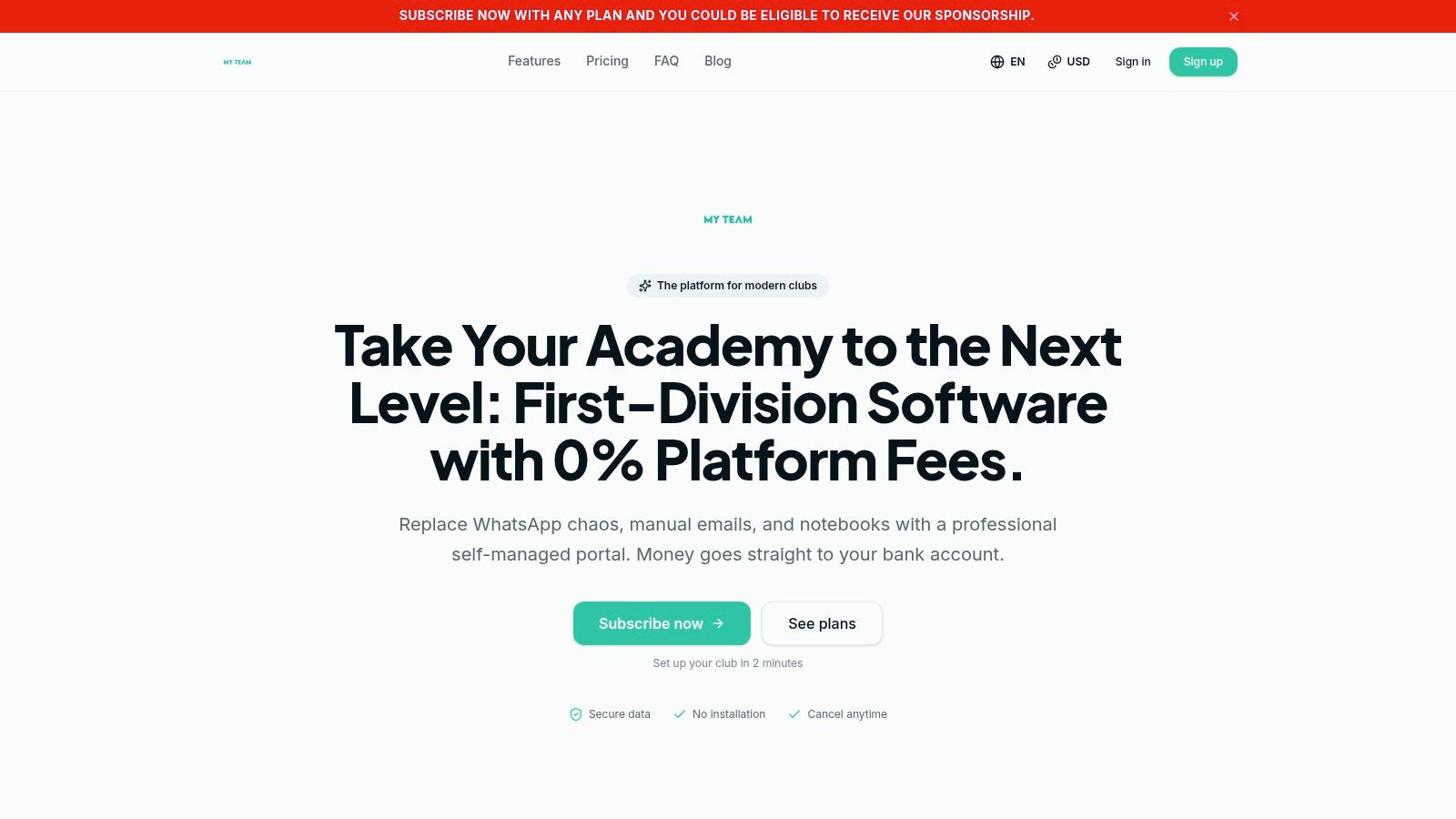
The platform can also support the reporting foundation behind youth sports sponsorships. Accurate rosters help establish participation reach. Clear payment records help separate expected revenue from collected revenue. Documented sponsor benefits help directors show whether a partnership funded equipment, access, or another agreed outcome. More details on youth sports management software for clubs and academies are relevant when sponsorship administration becomes part of a broader financial workflow.
A sponsor won't renew because a club owns software. A sponsor renews when the club delivers value, protects trust, collects revenue reliably, and proves what happened. Professional financial automation gives directors the records and consistency required to do that work at scale.
MY TEAM ONLINE offers sports academies a centralized way to automate tuition collection, manage sponsor and family records, monitor outstanding balances, and retain 100% of payment funds through its 0% commission model. Academy directors and club owners can visit MY TEAM ONLINE to subscribe or download strategic management guides for building more professional, scalable operations.