Team Communication App for Sports Clubs: A Guide
A modern team communication app is essential for sports clubs, with 74% of companies using workplace messaging tools for internal communication and 64% of employees preferring instant messaging at work. The right platform must do more than facilitate group chats, it must automate fee collection, manage rosters securely, and reduce administrative overhead.
A club director may start the week answering parent messages, checking attendance spreadsheets, forwarding schedule changes, and chasing unpaid tuition. By Friday, the same director is still searching for a player document buried in a chat thread while a coach asks for the latest roster and a treasurer asks which families have paid.
That isn't a communication problem alone. It's an operating problem.
A formal academy needs a central system that connects people, records, permissions, schedules, documents, and financial actions. A casual chat group can support coordination for a single match. It can't reliably run a growing sports business.
Table of Contents
- Why Sports Clubs Need a Dedicated Team Communication App
- Core Features That Matter for Club Administration
- How to Select the Right Platform for Your Academy
- The Financial Impact of Specialized Sports Management Tools
- Overcoming Common Myths About Club Management Software
- Professionalizing Your Club with MY TEAM ONLINE
Why Sports Clubs Need a Dedicated Team Communication App
A youth academy can lose control of its finances through small administrative gaps. One age group uses a chat for updates, coaches rely on another, fee records sit in a spreadsheet, player documents live in a shared folder, and payment confirmations arrive through separate channels. Each choice appears manageable. Together, they create a system built on memory, manual checking, and repeated data entry.
A director managing several training groups sees the consequences quickly. A parent announces a payment in one conversation. A coach posts a roster change elsewhere. An administrator updates the spreadsheet later, while the finance coordinator misses the change until reconciliation. A new medical document remains in a phone gallery because the club never established where official files belong.

General-purpose messaging is fast and familiar, so clubs adopt it early. A dedicated team communication app must manage more than conversation. It needs to organize membership records, role permissions, fee status, player profiles, and administrative accountability so that messages support an official process instead of becoming the process.
The breaking point is operational, not social
A club reaches its limit when staff cannot answer basic questions quickly:
- Which players are registered in each group?
- Which families have an outstanding balance?
- Who can access private parent communications?
- Where is the current consent form?
- Which coach is authorized to edit a roster?
- What happened after a payment reminder was sent?
A dedicated app answers these questions through structured records rather than chat history. It becomes the club's central nervous system, connecting coaching, administration, finance, and parent communication. That connection protects revenue by linking payment information to the right family, preserving documents in the right place, and giving administrators a record they can verify.
Operational rule: If an important action exists only in a chat message, the club does not have a reliable process.
Workplace communication platforms recorded 894% growth in usage from March to June 2020, according to this documented adoption history for workplace communication. Youth academies now face the same pressure to centralize updates, payments, and documents in one verifiable system.
Fragmentation remains costly. 91% of businesses use at least two messaging apps, while the average company uses 3.3 chat tools, as reported in this workplace messaging analysis. In a sports club, every additional channel creates another place for a payment confirmation, roster change, or medical document to disappear. The result is delayed reconciliation, avoidable follow-up, and weaker control over sensitive information.
Formal clubs should separate casual coordination from organizational management. Casual coordination helps people exchange updates. Organizational management ensures that the right person receives the right information, takes the required action, and leaves a record another administrator can verify.
A club should therefore set clear ownership, permissions, and follow-up rules before adding more chat groups. These team communication practices for organized clubs help turn communication into accountable administration.
Core Features That Matter for Club Administration
A team communication app should serve as the club's central nervous system. Its value lies in connecting messages with permissions, records, and financial follow-up, not in offering an attractive chat screen. Directors should judge each feature by the administrative failure it prevents: duplicate entry, missed payment action, exposed youth records, or an undocumented decision.
Youth-sports management platforms are commonly designed as broader operating systems. They may cover registration, rostering, scheduling, communication, online payment processing, athlete tracking, and tournament management. This overview of youth sports management platforms supports a practical conclusion: a growing academy needs connected administration rather than another place to exchange messages.
Role-based access controls who sees what
A coach should not automatically see finance records. A finance administrator may not need access to private parent conversations. Parents should receive information about their own player without gaining access to an academy-wide contact database.
Role-based access separates these responsibilities. Administrators can manage membership and settings, coaches can work with assigned rosters, and finance staff can handle fee records within their remit. A review of team communication app requirements identifies RBAC, audit logs, secure logins, and administrative controls as baseline governance features. Require those controls before moving club operations into a shared system.
File security deserves the same attention. Player documents, billing notes, emergency contacts, and staff messages need protection while moving across a network and while stored. A suitable platform should enforce encryption in transit and at rest, with TLS and SRTP for network communications by default, as described in its team security guide. Treat encryption as a required system capability, not an informal assurance.
Roster and billing records must connect
A roster links a player to a parent contact, training group, coach, attendance record, documents, and financial account. If those records sit in separate files, a single change can create conflicting versions. Staff then spend time checking spreadsheets instead of resolving exceptions and collecting fees.
A specialist platform should allow the club to:
- Maintain one player profile: Store contacts, photos, documents, groups, and relevant account information in a controlled record.
- Assign responsibilities clearly: Give coaches access to their groups while reserving financial actions for authorized staff.
- Send operational notices: Connect schedule, attendance, and roster updates to the people affected.
- Track financial status: Show paid, pending, and overdue accounts without forcing staff to reconcile multiple spreadsheets.
- Retain useful records: Keep receipts, approvals, and communication history available for later review.
Communication should trigger action
A message has administrative value only when the required next step remains visible. A billing notification should connect to an account status. A roster update should reach the assigned coach. A document request should stay open until the record is complete.
That workflow protects revenue and reduces follow-up. Chat records conversations. Club management software coordinates decisions, permissions, payment status, and completion.
Before approving a platform, administrators should review these data security practices for sports organizations. A club holding youth records must treat security as part of daily operations, alongside financial controls and staff accountability. Parents and staff should know who can access information, how records are protected, and where the club can verify each action.
How to Select the Right Platform for Your Academy
A youth academy can lose control before anyone notices. A registration sits unapproved, a player joins the wrong group, a payment remains unrecorded, and a departing coach still has access to family data. The right team communication app connects these decisions across the club's operating cycle, from registration and roster assignment to payment collection, renewal, and staff offboarding.
Start with the work, not the feature list.
Begin with the club's real workflows
Map how a family joins, who approves the registration, how the player enters a group, how schedule information reaches the right people, and how monthly fees are recorded. Include exceptions such as late payments, group transfers, missing documents, and staff changes. These exceptions expose whether the system supports administration or stores conversations.
A platform should carry each process forward without forcing staff to export data after every step. Youth sports software is expected to combine registration, rostering, scheduling, communication, payments, and tracking. Evaluate those functions as one operating system, because disconnected records create extra work and make financial responsibility harder to identify.
Test permissions through real club roles
A director tests access by logging in as an administrator, coach, finance user, and parent during one session. The test should answer five practical questions:
| Role | Required result |
|---|---|
| Administrator | Creates a player record and assigns the correct group |
| Coach | Sees the roster and information needed for training |
| Finance user | Checks an outstanding account and records a payment |
| Parent | Receives a relevant notice without seeing another family's data |
| Departing staff member | Loses access immediately |
This exercise exposes weak permission structures quickly. If staff must rely on manual instructions to avoid opening confidential records, the platform is unsuitable for a formal club, especially one managing youth records.
Auditability matters just as much. Directors need to identify who changed a roster, approved a payment, uploaded a document, or removed a user. A clear history reduces disputes, supports handovers, and gives finance staff evidence when account details are questioned.
Check communication beyond the office
An academy has coaches on the move, parents using phones, administrators at desks, and families who do not check the same channel consistently. A 2025 North America survey found that 21.3% named a dedicated chat app as their most-used platform, compared with 20.7% for SMS, 20.0% for another workplace suite, and 17.0% for email. It also found that 71% had a backup communication system, while 54.3% said SMS was the most effective way to reach non-desk workers, according to this survey of mobile collaboration and communication habits.
The operational lesson is clear. Choose reliable mobile access, clear notifications, and a defined fallback process for urgent messages. A club should not assume that every coach or parent behaves like a desk-based employee. Communication failure can delay attendance decisions, leave families without payment instructions, and create avoidable follow-up.
Confirm integration and room to grow
A multi-sport academy may begin with one discipline and add others later. The system should handle different training structures, age categories, payment models, and staff permissions without creating a separate database for each sport.
Before signing, assess data export, payment connectivity, support quality, onboarding, and contract flexibility. AI-assisted functions can summarize conversations and extract action items, but they must support defined workflows rather than produce more noise. Recent industry commentary describes AI moving toward summaries, action-item extraction, smart replies, and workflow support, as discussed in this analysis of messaging platforms and AI coordination.
Choose the platform that makes routine administration predictable for staff, protects financial records, and keeps responsibilities understandable for families.
The Financial Impact of Specialized Sports Management Tools
A youth academy can collect every monthly fee and still lose money through processing charges, delayed follow-up, and unclear account ownership. Staff time disappears into message searches, spreadsheet checks, and repeated requests for payment. A team communication app should therefore connect communication with financial administration, making the club's cash flow visible and actionable.
The operating comparison is clear:
| Approach | Administrative result | Financial risk |
|---|---|---|
| Manual spreadsheet and chat | Staff check records and contact families individually | Follow-up is missed and status updates become inconsistent |
| Generic payment workflow | Payments may be processed while club records remain fragmented | Fees and reconciliation work reduce net revenue |
| Specialized club system | Billing status, reminders, receipts, and member records stay connected | Fewer manual handoffs and clearer responsibility |
| 0% commission model | The academy retains the full collected amount under the stated model | Approval and payment procedures still require defined ownership |
A 0% commission model directly improves the collection calculation. For a 120-player academy charging $80 per month, retaining the full amount instead of losing 3% to processing saves $288 each month, or $3,456 each year. That recovered margin can fund equipment, facility costs, or an assistant coach. The financial benefit appears with every successful payment, provided the platform's terms support the stated model.

Automation replaces repeated chasing
Fee collection should begin before an account becomes overdue. A defined cadence sends reminders seven days before the due date, on the due date, and at intervals afterward, then updates the account when payment arrives. The process described in this sports-club payment reminder workflow shows why scheduled follow-up works better than improvised messages.
Administrators need a visible queue:
- Upcoming: A reminder prepares the family before the charge is due.
- Due today: The system confirms the payment request at the right time.
- Overdue: Follow-up continues without a spreadsheet search.
- Paid: The account status changes when payment is recorded.
- Escalated: Staff review only cases requiring personal intervention, using this team manager app guide to structure the workflow.
Fee-collection systems for sports clubs keep membership fees, instalments, reminders, and payment status in one place, as outlined in this sports-club fee collection guide. That shared record matters in formal clubs with multiple coaches, age groups, and administrators. Everyone works from the same status instead of relying on private messages or outdated files.
Retention begins with financial clarity
A late payment may reflect confusion, temporary difficulty, or an approaching departure. Staff should separate routine overdue accounts from cases that need personal contact. Automated reminders create a consistent baseline, while the communication app gives administrators a controlled way to resolve exceptions.
Renewals need the same structure. Notify members before charges or fee changes, then use a reminder, final notice, and lapse-reason survey to distinguish intended renewal from active churn. A structured membership renewal workflow connects billing administration with retention decisions.
A team communication app earns its place when it protects revenue and reduces administrative chasing. The strongest operating model combines 0% commission economics, automated reminders, visible balances, and clear responsibility for unresolved accounts.
Overcoming Common Myths About Club Management Software
A youth academy can lose control of fees, documents, and parent updates without realizing the cause. A coach keeps attendance in one place, a treasurer tracks payments in another, and the director relies on messages to confirm what was agreed. That fragmentation creates administrative risk during registration, renewals, and monthly collection.
Club directors often delay digital administration because they have seen complicated systems fail during busy registration periods. The concern is valid. Keeping spreadsheets indefinitely is the worse decision. Choose software that fits the club's working routines, then introduce structure around the records and payments that affect operations now.
You do not need to digitize every historical record first
Start with the next billing cycle. Load current players, active groups, upcoming fees, and the staff responsible for each task. For example, an academy can move its U12 roster and outstanding registrations into the system before importing archived records from previous seasons. Older documents can follow once the current process is stable.
Cloud-based software also reduces installation work. Staff access the service through supported devices while the provider manages the underlying system. Directors still need an adoption plan, but they do not need to build and maintain internal infrastructure.
Staff need role-based instruction, not database training
A finance volunteer should be able to approve 30 payment receipts in one queue in under 10 minutes. A coach should learn only how to update attendance and send an operational notice to the assigned U12 group. Neither person needs to understand database architecture.
Training should follow responsibility:
- Administrators: Own setup, permissions, records, and reporting.
- Coaches: Manage assigned groups and operational updates.
- Finance staff: Review balances, payment records, and reminders.
- Parents: Receive notices, submit requested information, and confirm payments.
This division limits errors. Each user learns the actions that protect their part of the club's workflow.
A communication app creates noise only when the club governs it poorly
A structured system separates announcements, group updates, private records, and financial actions. Set a clear rule: a message can notify people, while a structured record confirms what happened.
Governance principle: A message can notify people, but a structured record should confirm what happened.
That distinction matters when a parent disputes a missed payment, a coach changes a training group, or an administrator needs proof that a registration document was submitted.
The return comes from preventing administrative leakage
Software costs less than the recurring losses caused by unpaid fees, duplicate work, late renewals, missing documents, and conflicting records. Directors should assess whether staff close accounts faster, identify overdue balances earlier, answer parent questions without searching multiple channels, and complete registrations with fewer manual steps.
Track those outcomes against the club's actual workload. A platform earns its place when it protects revenue, clarifies responsibility, and reduces the time spent reconciling information. Administration is a financial function, not background paperwork.
Professionalizing Your Club with MY TEAM ONLINE
Professional administration gives coaches more time to develop athletes and gives directors better control over the business. A club doesn't need a separate tool for every conversation, roster, document, and payment decision. It needs one environment where those records connect and where each staff member sees the work appropriate to their role.
A strong team communication app should support secure roster management, controlled file access, mobile updates, financial visibility, and automated fee follow-up. For a formal academy, those capabilities matter more than a busy chat feed. They protect revenue, improve parent confidence, and make growth less dependent on one administrator's memory.
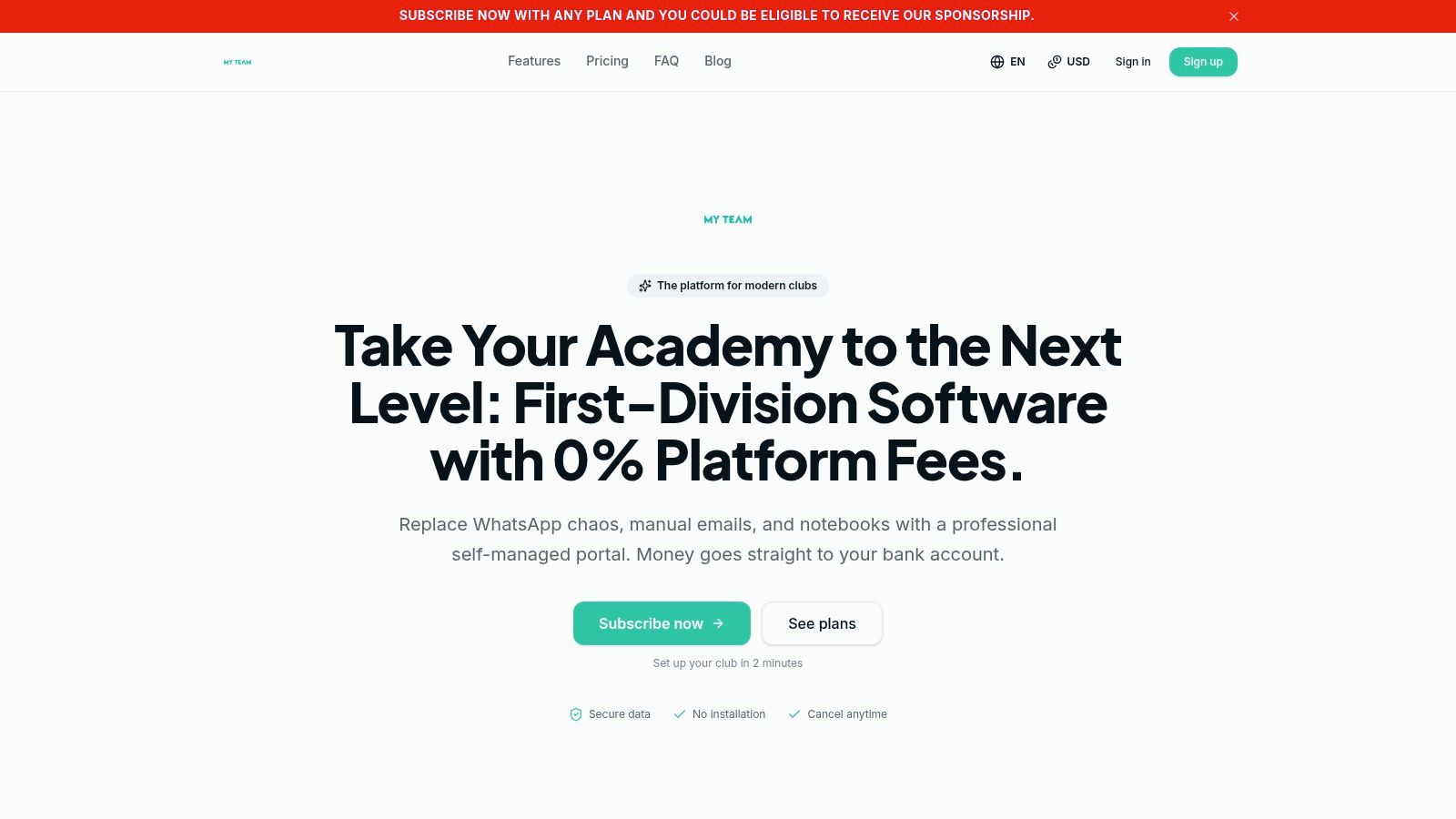
MY TEAM ONLINE brings club administration into a central cloud platform with roster management, secure roles, payment tracking, automated reminders, and a 0% commission model for academy payment processing. That combination addresses the two problems that undermine many sports businesses: fragmented administration and avoidable revenue leakage.
The next step is a controlled transition. Directors should document the current payment and roster process, assign staff permissions, move active records into a structured system, and establish a clear reminder policy. Professional operations begin when the club stops treating administration as a collection of urgent tasks and starts managing it as a repeatable business system.
MY TEAM ONLINE centralizes rosters, documents, communication, and fee administration while allowing academies to keep 100% of collected funds through its 0% commission model. Club directors can visit MY TEAM ONLINE to subscribe to the platform or download strategic management guides for building a more professional, financially controlled academy.